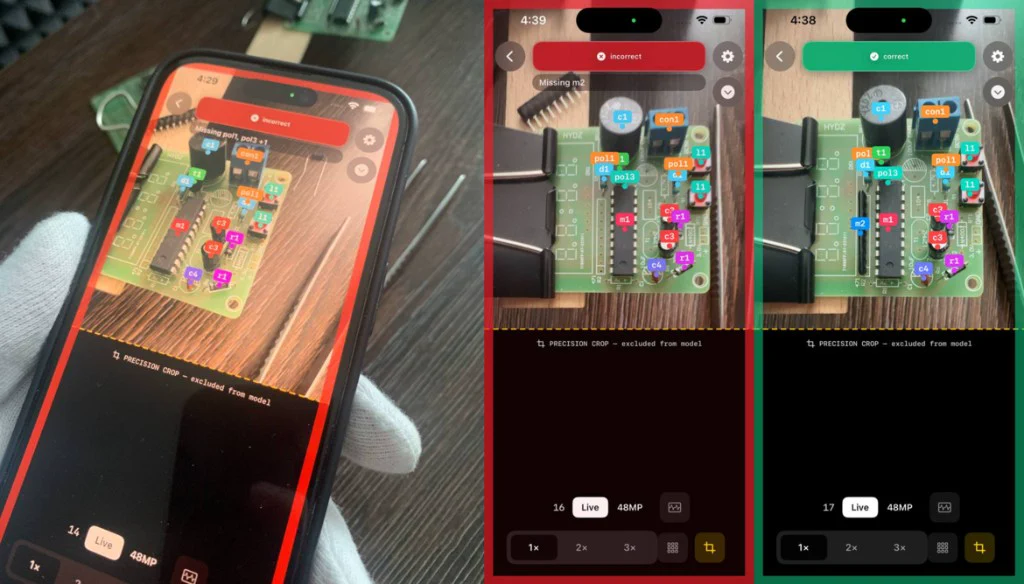
Inventor — incorrect (left) and correct (right) verdict on a PTH PCB assembly
Starting in May 2026, Spiral ships Inventor for through-hole PCB assembly validation. We’ve designed it for the realities of avionics, defense electronics, medical devices, and specialized equipment where traditional fixed inspection systems are economically impractical and manual inspection is unreliable.
What it checks
This configuration of Inventor also runs on standard iPhones and iPads with all the flexibility of mobile devices. The operator points the camera at the board; on-device computer vision checks each component for presence, correct placement, and proper polarity orientation, and validates markings and reference designators against the approved bill of materials.
The system resolves components down to 0.5 mm and supports up to 250 component types. A new board variant is configured in under 30 minutes. In the demo below, the system first flags a missing component, clears the finding once the component is reinstated, and then catches reversed polarity on a 3 mm-wide component detecting its special surface marking.
Missing component and reversed polarity detection on a live PTH board
Accuracy in practice
Inventor works with items as small as 0.5 mm (0.020″) which allows it to catch the failure modes manual PTH inspection misses most often — reversed polarity on diodes and electrolytics, misoriented connectors, and swapped or illegible reference designators — without a microscope pass on every board.
Live zoom on a 0.5 mm feature — caliper reference at 0.49 mm on the right
Flexible setup
Inventor fits however the bench is laid out — handheld, on a hinge above the work surface, or on a tripod with boards presented to the camera — and stays stable when the operator moves in for a dense connector field or steps back for a full-board view. Hand shake, lighting shifts, and working-distance changes do not throw off the verdict the way they would on a fixed AOI rig locked to one distance and one lighting setup.
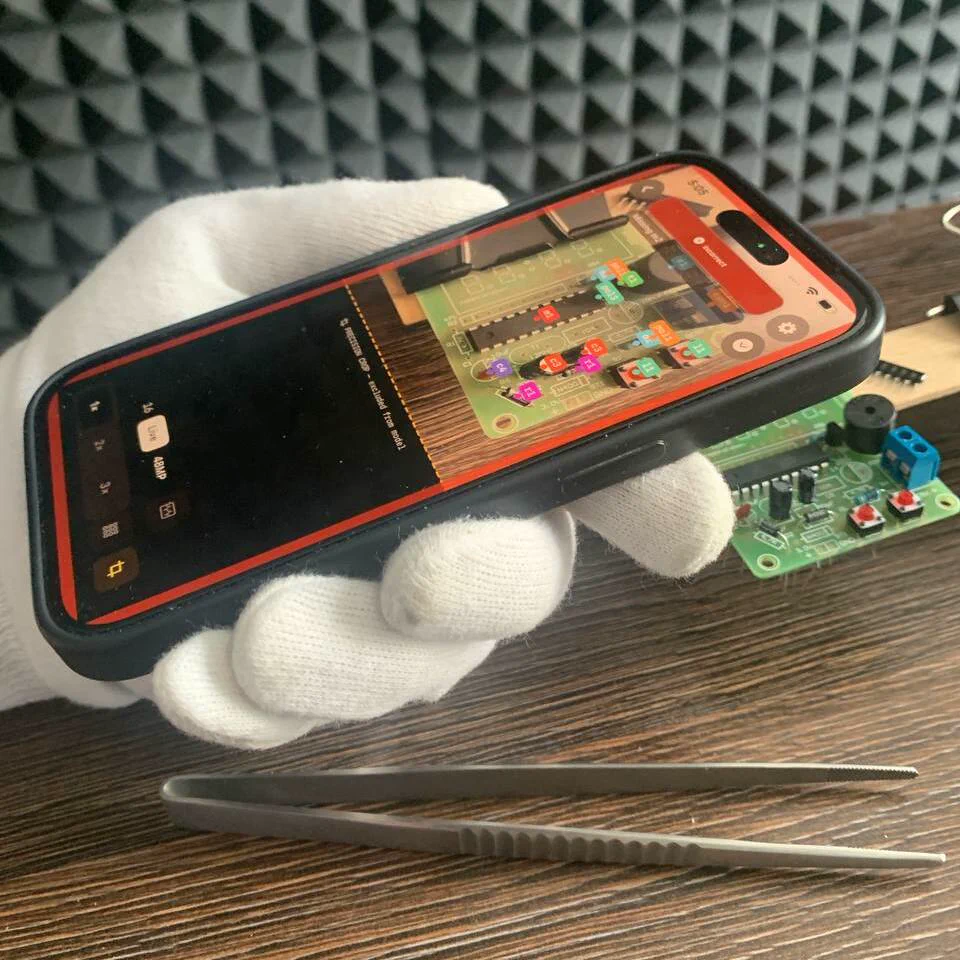
INVENTOR in operation
On-device, no data egress
In Aerospace and Defense, inspection imagery is as sensitive as the parts themselves. Every frame is processed on the iPhone and nothing is uploaded to a cloud service, so audit trails stay inside your facility — which is what ITAR programs and ISO 9001 / AS9100 traceability audits expect when you document how visual checks were performed.
Marking
Finally, the marking on every component can now be accurately checked against the specification. Inventor reads component values in hard-to-reach spots, upside down, or on curved surfaces — or all of those at once. That helps both with new builds and when you need to evaluate or reconstruct a legacy board.
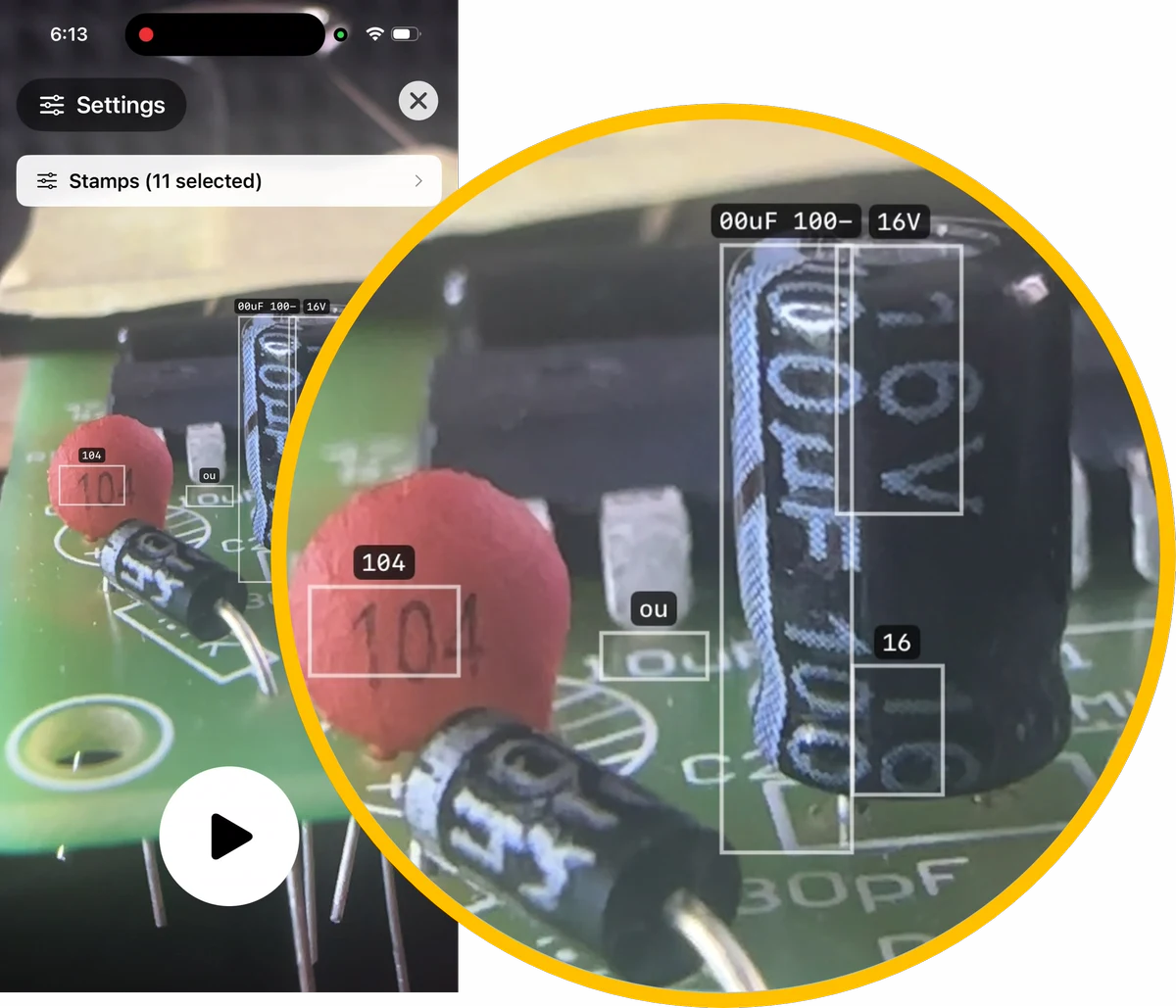
Marking verification — live read of component values against the specification