
Wind Systems editor Kenneth Carter profiles Spiral, following the company from the Air Force Innovation Accelerator (AFWERX) to Roboscope on the blade shop floor.
Spiral started with a Tyndall Air Force Base contract and pilots at Singapore Airlines and Lufthansa, putting repair instructions in a HoloLens in front of aircraft mechanics on the tarmac. In 2020 the aerospace innovation programs folded. A quality manager at a major wind OEM was trying to expand output without expanding the building, and inspection was the bottleneck. Aircraft are composites, blades are composites, and the documentation problem is identical: record where the finding is.
When Microsoft discontinued the headset, the work moved to iPhone. Roboscope anchors each defect to its position on a 350-foot blade using iPhone LiDAR, currently at one to two inches, with one inch the target. The tape measure and the paper form go away.
Sessions run air-gapped on the device and sync to ERP or QMS when a connection is available. With one, markers appear on the virtual blade model in real time for remote review and export. Across plants in Brazil, China, and India, the same defect produces the same record regardless of who is on shift.
The profile also covers the two OEM deployments now running, and Spiral’s position on where the operator sits in an AI-heavy factory: the human stays in the loop for the complex engineering calls.
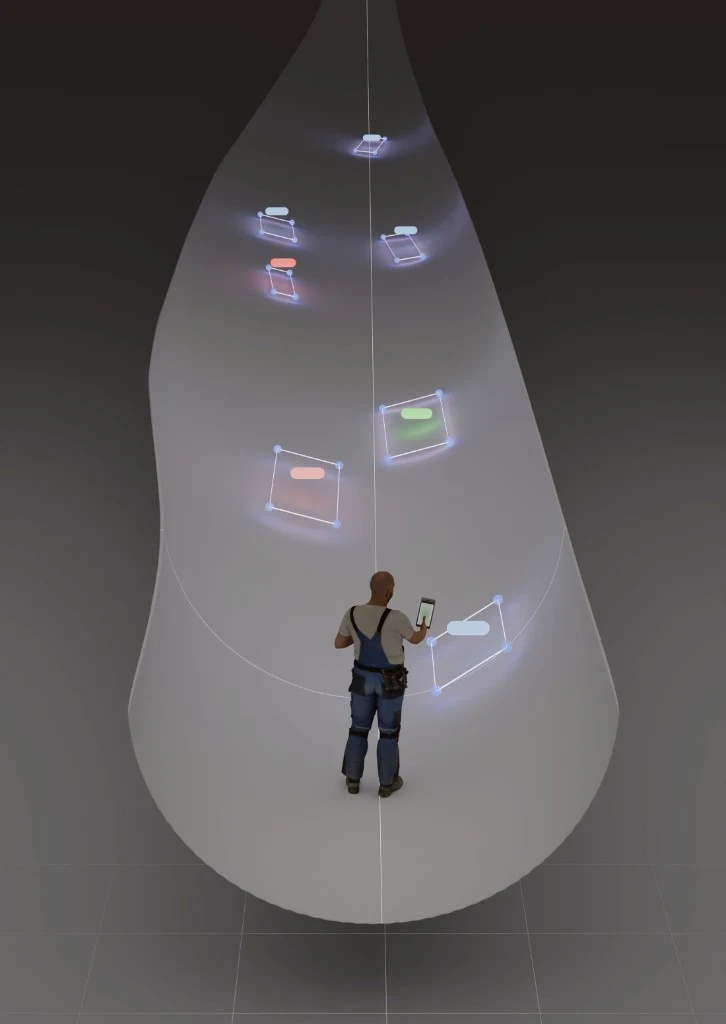
Roboscope anchors each finding to its exact position in 3D — no tape measure, no paper form.